
ChildrenMyopia controlPrevention
Your child’s glasses keep getting stronger. That is the part to act on
Short-sightedness in Nepali children is climbing, and each year of progression matters for the eye they will have at forty. What causes it, what the evidence says slows it down, and what is worth doing this week.
By Sight Savers Eye Clinic & OpticalsJhamsikhel, Lalitpur5 min readUpdated
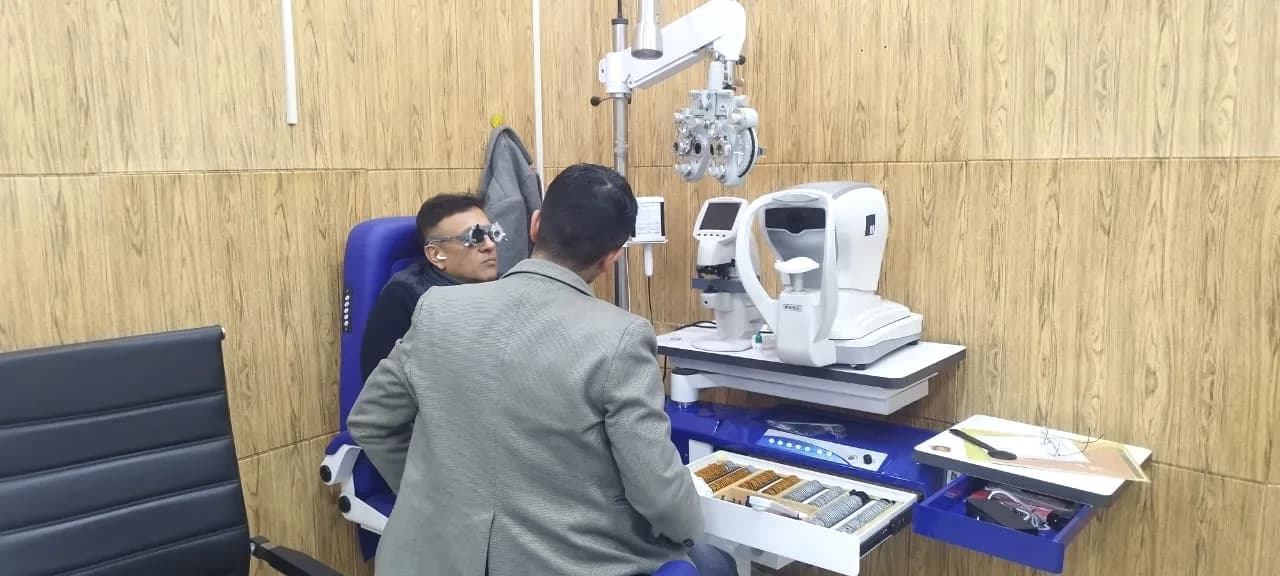
A parent brings in a nine-year-old whose glasses were changed last year and are already too weak. The question is always the same, and it is the right question: is this going to keep happening?
Often, yes — and that is precisely why it is worth doing something now rather than waiting. Myopia is not simply an inconvenience corrected by a stronger lens each year. It is the eyeball growing too long, and the longer it grows the higher the lifetime risk of retinal detachment, myopic maculopathy, glaucoma and early cataract. Those risks rise steeply beyond about −6.00 dioptres. The aim of treating a child is not to make this year’s vision sharper; a lens does that. The aim is to reduce the number they finish growing on.
Why it is becoming more common
Myopia is rising across urban Asia, and Kathmandu Valley is following the same pattern for the same reasons. Two stand out, and one of them is more surprising than parents expect.
The first is time spent outdoors — or rather the lack of it. Outdoor light is orders of magnitude brighter than indoor light, and bright light appears to slow the axial growth of the eye. Studies that added around 40 minutes of outdoor time to the school day reduced the number of children who became myopic. This is the single best-supported preventive measure there is, and it costs nothing.
The second is sustained near work: books, tuition, and increasingly phones held far too close. The link is less clean than the outdoor one, but close, prolonged, unbroken near work is consistently associated with progression.
Genetics sets the background risk. One short-sighted parent roughly doubles a child’s chances; two roughly quadruples them. You cannot change that, but it tells you which children to watch closely and test early.
Signs worth acting on
- Sitting close to the television, or moving to the front of the class to read the board.
- Holding a book or a phone unusually close to the face.
- Squinting or half-closing the eyes to see across a room.
- Complaining of headaches after school, or rubbing the eyes a lot.
- Losing interest in reading, or in sport played at a distance.
- One eye that turns in or drifts, even occasionally.
A child will rarely say "I cannot see". Children assume everyone sees what they see. Where one eye is affected and the other is not, there may be no complaint at all — which is the argument for testing rather than waiting to be told.
What actually slows progression
Ordinary single-vision spectacles correct the blur. They do not slow the growth. Several things do, and they can be combined.
Time outdoors
Aim for roughly two hours a day. It does not have to be sport; sitting outside counts. This is protective mainly against becoming myopic in the first place, so it matters most for younger siblings and children not yet affected.
Low-dose atropine eye drops
A very dilute atropine drop at night is one of the best-evidenced treatments for slowing progression. At low concentrations, side effects are usually mild — some light sensitivity, occasionally slightly reduced near focus. It requires a prescription, follow-up and a plan for stopping, because progression can rebound if it is withdrawn abruptly. It is not something to source informally.
Myopia-control spectacle lenses
Lenses with concentric zones that deliberately defocus peripheral light have shown meaningful reductions in progression in trials. They look and are worn like ordinary glasses, which makes them the easiest option for most families to sustain.
Orthokeratology and soft multifocal contact lenses
Orthokeratology — rigid lenses worn overnight that reshape the cornea, giving clear vision through the day without glasses — also slows progression, and suits older children and teenagers who want to be free of spectacles for sport. It demands careful fitting, scrupulous hygiene and regular review; the main risk is infection, and it is a real one if lens care is casual. Daily-wear soft multifocal lenses are an alternative with a similar effect.
Sensible near-work habits
- Keep reading material about an elbow-to-knuckle distance from the eyes.
- A break every 30 minutes, looking into the distance for a minute or two.
- Read in good light, and avoid reading lying down.
- Keep phones and tablets at arm’s length rather than at the nose.
What does not work
Deliberately under-correcting a child’s glasses to "make the eyes work harder" was once common advice. It has been tested, and it makes progression faster, not slower. Eye exercises do not reverse myopia — they have a genuine role in eye-teaming and focusing problems, which are a different condition entirely. And no diet, supplement or drop restores an eye that has already grown longer. The length is structural. What is achievable is slowing what happens next, and that window is childhood.
If your child’s prescription has moved more than about half a dioptre in a year, that is the point to ask about myopia control rather than simply to order stronger lenses.
Common questions
- At what age should a child have their first eye test?
- By six months if there is any family history or visible concern, again before starting school, and every one to two years through the school years. Children with a short-sighted parent, or who already wear glasses, should be seen annually.
- Will wearing glasses make my child’s eyes weaker?
- No. This is the most common myth we hear. Correcting the vision does not accelerate myopia. Deliberately under-correcting, on the other hand, has been shown to make progression faster.
- Can screen time alone cause short-sightedness?
- Screens are part of a broader pattern of prolonged near work and reduced time outdoors, and that pattern is linked to myopia. Time outdoors is the factor with the strongest evidence behind it, so the most useful change is usually adding outdoor time rather than only removing screens.
- Is myopia control treatment available in Kathmandu?
- Yes. Low-dose atropine, myopia-control spectacle lenses, orthokeratology and soft multifocal contact lenses are all available in the valley. Which is appropriate depends on the child’s age, current prescription, rate of progression and how reliably they can manage lens hygiene.
Read next
Your eyes hurt by 4 p.m. Here is what is actually going on
Sore, dry, heavy eyes after a day at a screen are not imagined and not permanent damage — but they are a signal. What causes computer vision syndrome, what genuinely helps, and when it is worth getting your eyes checked.
Cataract: how to know it is time, and what the surgery is really like
Cataract is the most common cause of reversible blindness in Nepal, and the operation is one of the most successful in medicine. What the early signs are, how to judge when to have it done, and what recovery actually involves.