
CataractSurgeryOver 50
Cataract: how to know it is time, and what the surgery is really like
Cataract is the most common cause of reversible blindness in Nepal, and the operation is one of the most successful in medicine. What the early signs are, how to judge when to have it done, and what recovery actually involves.
By Sight Savers Eye Clinic & OpticalsJhamsikhel, Lalitpur6 min readUpdated
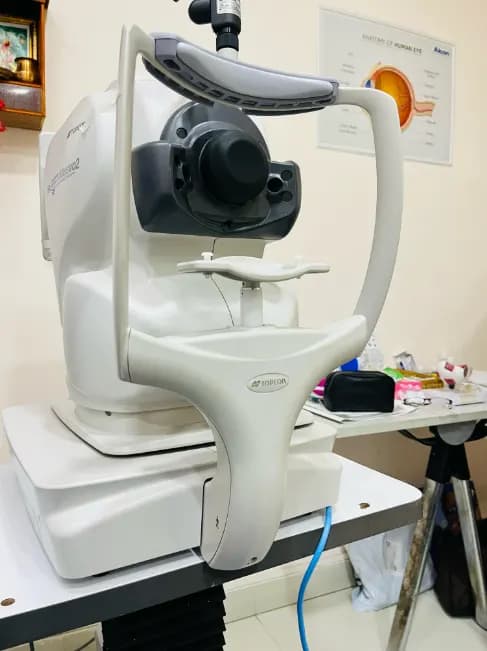
A cataract is the natural lens inside the eye becoming cloudy. It is not a growth, not a film over the eye, and not something that can be dissolved with drops. It is the lens itself losing its clarity with age — and it is the leading cause of blindness in Nepal that can be reversed completely.
That last point is the one worth holding on to. A cataract that has taken years to develop can be removed in about fifteen minutes, and most people are seeing better the following day.
How it starts
Rarely with a dramatic loss of vision. Far more often with a slow drift that is easy to attribute to age or tiredness:
- Colours look washed out, or slightly yellow-brown. Whites stop looking white.
- Headlights and streetlights throw haloes and starbursts, and night driving becomes uncomfortable.
- Bright sunlight is dazzling in a way it never used to be.
- Your glasses prescription changes more often than it used to.
- Reading becomes possible without glasses again — "second sight", which sounds like good news and is in fact a common early sign.
- Double vision in one eye, which stays double when you cover the other.
Because the change is gradual, most people adjust without noticing how much they have given up. It is common for someone to say after surgery that they had not realised how dim things had become.
When is it time?
The old advice was to wait until the cataract was "ripe". That belongs to an era of larger incisions and different technique. Today the answer is simpler and more personal: when it interferes with the life you actually lead.
For a driver, that may come early, because glare at night is disabling. For someone who reads and cooks at home, it may be years later. There is no threshold on a chart that decides it for you, and there is no benefit in enduring poor vision to earn the operation.
There are situations where waiting carries a genuine cost. A cataract left until it is very dense is harder to remove and carries a higher complication rate. Very advanced cataract can raise the pressure inside the eye and cause a painful form of glaucoma. And if a cataract is dense enough to stop the surgeon examining your retina, other disease can hide behind it. Those are medical reasons to proceed rather than to wait.
What the operation involves
Modern cataract surgery is phacoemulsification. Through an incision of around 2–3 mm the cloudy lens is broken up with ultrasound and removed, and a clear artificial lens — an intraocular lens, or IOL — is folded, inserted, and unfolds into the space the natural lens occupied. The incision is usually small enough to seal itself without stitches.
It is done under local anaesthetic — drops, or a small injection around the eye. You are awake but the eye is numb. You will see light and movement, not the procedure. Most cases take fifteen to thirty minutes and you go home the same day.
Choosing the lens
This is the decision that shapes what your vision is like afterwards, and it is worth a proper conversation before the day.
Monofocal
Set for one distance, usually far. Vision at that distance is crisp and reliable, and you wear reading glasses for close work. It is the standard choice, the most predictable, and the least expensive.
Toric
A monofocal lens that also corrects significant astigmatism. Worth it where the astigmatism is high enough that a standard lens would leave you dependent on glasses for distance as well.
Multifocal and extended-depth-of-focus
These aim to give useful vision at more than one distance and reduce dependence on glasses. They deliver that for many people, but with a trade-off that should be stated plainly: more haloes and glare around lights at night, and slightly less crispness in dim conditions. If you drive at night a great deal, or your work demands fine detail in low light, a monofocal often gives a better result.
The lens power is calculated from measurements of your eye taken before surgery. The calculation is good but not perfect, and a small residual prescription afterwards is normal rather than a sign anything went wrong.
Recovery, honestly
- 1Day one: vision is often noticeably better already, though it may be hazy and the eye can feel gritty. You will be reviewed the day after surgery.
- 2The first week: antibiotic and anti-inflammatory drops on a tapering schedule. Do not rub the eye. Keep water, soap and dust out of it — no swimming, and take care washing your hair.
- 3The first two to four weeks: avoid heavy lifting, straining, and dusty environments. Most people return to desk work within a few days.
- 4Around four to six weeks: the eye has stabilised and your final spectacle prescription can be measured. Ordering new glasses before this point usually means paying twice.
Success rates are high — the great majority of eyes without other disease achieve good vision. Complications are uncommon but not impossible, and infection inside the eye, though rare, is serious. Contact your surgeon urgently, not at the next appointment, if you have increasing pain, vision that is getting worse rather than better, a sudden shower of new floaters, or flashing lights.
Months or years later, the membrane the lens sits in can itself become cloudy — posterior capsule opacification, sometimes called an after-cataract. It is common and it is not the cataract returning. It is treated with a painless outpatient laser that takes a few minutes.
What to bring to the consultation
- Your current glasses, and any previous prescriptions you have kept.
- A list of all medicines you take. Alpha-blockers taken for the prostate — tamsulosin in particular — affect how the pupil behaves during surgery, and the surgeon must know beforehand, even if you stopped taking them years ago.
- Details of diabetes, high blood pressure, or any previous eye injury, inflammation or surgery.
- A clear sense of what you most want to be able to do without glasses. That answer drives the lens choice more than anything else.
Common questions
- Can cataracts be cured with eye drops or medicine?
- No. Despite what is sometimes advertised, no drop, tablet or exercise reverses a cataract. The clouded lens has to be removed and replaced. Surgery is the only established treatment.
- Is cataract surgery painful?
- The eye is numbed with drops or a local injection, so the procedure itself is not painful. Afterwards the eye commonly feels gritty or scratchy for a few days. Significant or increasing pain is not expected and should be reported straight away.
- How soon can I go back to work after cataract surgery?
- Most people doing desk work return within a few days. Dusty, heavy or strenuous work needs longer — usually two to four weeks. Your surgeon will advise based on the eye and the job.
- Will I still need glasses after cataract surgery?
- With a standard monofocal lens, usually yes for reading. Multifocal and extended-depth-of-focus lenses reduce that dependence but can cause more glare and haloes at night. A small residual prescription after any lens is normal.
- Can a cataract come back after surgery?
- The cataract itself cannot return, because the natural lens has been removed. The membrane holding the new lens can cloud over months or years later, which is treated with a short, painless outpatient laser.
Read next

Your eyes hurt by 4 p.m. Here is what is actually going on
Sore, dry, heavy eyes after a day at a screen are not imagined and not permanent damage — but they are a signal. What causes computer vision syndrome, what genuinely helps, and when it is worth getting your eyes checked.

Your child’s glasses keep getting stronger. That is the part to act on
Short-sightedness in Nepali children is climbing, and each year of progression matters for the eye they will have at forty. What causes it, what the evidence says slows it down, and what is worth doing this week.